YETI: How a Cooler Became a Cult Brand

In the highly competitive outdoor accessory market, a management example has emerged that defies all traditional logic. How is it possible for a product as rudimentary as a portable cooler to command price tags upwards of 400 dollars? The answer does not lie in the plastic or the thermal insulation. Instead, it is found in a masterful execution of strategic marketing and community building.

From the perspective of the European Business School of Barcelona (ENEB), we analyze the YETI case as a paradigm of shifting a functional product into a cult object.

Throughout this article, we will break down how two brothers turned personal frustration into a multimillion-dollar empire. The organization’s success in 2026 is not an accident; it stems from a deep understanding of consumer psychology. They have successfully ensured that the customer doesn’t just buy a cooler, but a badge of identity and belonging.

The Origin of Disruption: Identifying an Unserved Need

The company’s story began in 2006, spearheaded by Roy and Ryan Seiders. Both brothers were avid hunting and fishing enthusiasts who shared a common complaint: the coolers on the market were cheap, but they broke easily. The handles gave out and the lids cracked after just a couple of seasons of heavy use.

Instead of competing on price in a “red ocean,” the brothers decided to build the cooler they would actually want to use. They weren’t targeting the mass market; they wanted the respect of professionals.

  • Focus on extreme durability: They aimed for unprecedented thermal capacity.
  • Manufacturing innovation: They utilized rotational molding (rotomolding), a costly technique that creates a single piece of seamless plastic.

While this process was unusual in the industry due to its high cost, it allowed them to create a virtually indestructible product. In doing so, they laid the foundation for a competitive advantage built on superior technical quality.

Pricing Strategy: Perceived Value Over Cost

When the first model hit the market at a price point of $300, the industry thought they were crazy. At the time, a standard cooler cost a mere $30 at any big-box retailer. However, this high price point acted as a filter for exclusivity and a hallmark of quality. The brand applied a premium pricing logic that turned the product into a status symbol.

The consumer perceived that if it cost ten times more, it must be ten times better.

By avoiding discounts and maintaining selective distribution, they protected both their margins and their prestige. A YETI customer does not feel like they spent money; they feel like they made a lifetime investment. This mindset reduces price sensitivity and fosters fierce brand loyalty.

The Product as a Badge for a Social Tribe

The company’s success is not limited to functionality; they capitalized on the human need for group belonging. Owning one of their products signals that you value authenticity and resilience.

It doesn’t matter if the user is a professional fisherman or someone simply heading to a local park. Carrying the logo automatically associates them with a rugged, adventurous lifestyle. The brand became the uniform for a tribe that rejects the disposable.

This emotional connection is what we call cult branding. The product becomes secondary to what it represents, turning customers into the ultimate brand advocates through organic social media sharing.

Building an Accessory Ecosystem

To maximize Customer Lifetime Value, the company intelligently diversified its catalog. They didn’t stop at large-format coolers; they introduced:

  • Tumblers
  • Mugs
  • Reusable bottles

These products feature a much more accessible entry price. This allows anyone to “step into” the brand without dropping $400. Once a customer experiences the performance of a tumbler, they are far more likely to purchase a cooler. This tactic drives repeat purchases that indestructible coolers cannot inherently offer, while boosting brand visibility in everyday urban environments like offices and gyms.

The Power of Storytelling: Selling a Culture, Not an Object

The company’s communication strategy is another one of its core pillars. Instead of traditional ads, they produce high-quality short documentaries titled “YETI Presents.” These pieces tell real-world stories of people living life on the edge, celebrating the outdoor lifestyle. The product appears naturally as an essential tool for the protagonist.

Their ambassador selection aligns perfectly with this vision. They don’t look for trendy influencers with millions of generic followers; they recruit fly-fishing legends, professional mountaineers, or traditional pitmasters. These are people who truly test the gear in hostile conditions. This authenticity validates the price tag in the eyes of experts—proving the brand is legitimate, not just marketing fluff.

The Impact of Scarcity and Limited Editions

Inventory management has also played a crucial role in their ascent. The brand frequently drops limited-edition colorways that often sell out within hours or days. This scarcity strategy triggers immediate buying urgency, eliminating consumer hesitation.

This consumer behavior mirrors that of luxury fashion or streetwear brands. By controlling supply, they keep demand consistently high and fuel a secondary collector’s market. This operational and sales tactic ensures a healthy cash flow while keeping the brand at the center of the digital conversation.

Lessons for Contemporary Business Leadership

From ENEB’s perspective, this case offers vital lessons in leadership and long-term vision. The company proved that niche specialization can lead to global dominance. They didn’t try to please everyone from day one; they focused on a small but passionate group and scaled their influence outward.

An executive must learn that quality should never be sacrificed for volume if prestige is the ultimate goal. Success in 2026 teaches us that customers are willing to pay more for truth and durability. In a world of planned obsolescence, being the brand built to last forever is the ultimate disruption.

Conclusion

The YETI case is proof that emotional value always triumphs over functional value in the premium market. They transformed a generic product into a cornerstone of their customers’ identity. For future leaders, this analysis underscores the importance of building communities, not just databases. If you can make your product the customer’s best ally in their daily battles, price becomes secondary.

Duolingo: Extreme Gamification

In today’s mobile application market, the battle is no longer fought over utility, but over time. Traditionally, educational tools faced an insurmountable obstacle: the lack of consistent motivation. Learning a language requires discipline, effort, and above all, time.

However, from the perspective of the European Business School of Barcelona (ENEB), we analyze the Duolingo case with sharp interest. This platform has successfully transformed the tedious nature of studying into a highly addictive experience.

In the year 2026, the app doesn’t just compete against other language tools. Its true rival is mass entertainment from platforms like TikTok or Netflix. Through extreme gamification, it has secured its business model, evolving from a simple learning app into a powerhouse within the product development sector.

Below, we break down how they leveraged psychology to retain millions of active users.

The Attention Challenge: Competing Against TikTok and Netflix

The greatest enemy of learning is not the difficulty of the subject matter, but instant gratification. Social media platforms are engineered to release dopamine in a matter of seconds. Faced with this, a traditional grammar textbook stands little chance.

The Duolingo team understood that to survive, they had to stop acting like a teacher and start acting like a video game developer. The goal was to capture those “micro-moments” of leisure that users typically spend endlessly scrolling.

  • Entertainment Aesthetics: The app was redesigned so every interaction feels rewarding, utilizing vibrant colors, celebratory sounds, and fluid animations.
  • Frictionless Delivery: Lessons are bite-sized and fast-paced. Users don’t feel like they are studying; they feel like they are playing a quick game on their subway commute.

For an executive, the lesson is clear: if your product demands effort from the consumer, you must compensate for it with an exceptional user experience (UX). Gamification is a structural necessity in industries with low natural retention.

The Psychological Keys to User Retention

Retention is the ultimate metric in the digital app ecosystem. Duolingo anchors its success on several cognitive biases that hook the user.

The most powerful is loss aversion: the app features mechanics that make users feel like they are losing something valuable if they skip a day of practice. This psychological design allows the app to maintain enviable activity rates compared to its competitors.

Additionally, the platform masters visual progression. Users always know exactly how close they are to reaching the next level (the perfect progress bar). Every completed lesson acts as a micro-victory that prompts the user to consume the next one immediately.

The Streak as a Driver of Daily Engagement

The concept of the “streak” is arguably the company’s most brilliant innovation. By prominently displaying the number of consecutive days a user has practiced, it builds an emotional commitment.

  • Psychological Exit Barrier: No one wants to break a 300-day streak due to a simple oversight. This mechanism exploits our need for consistency and pride in accumulated effort.
  • Smart Notifications: The app reinforces this with push notifications that leverage humor or mild guilt. This communication tone, embodied by their mascot, went viral online—turning interruption marketing into something celebrated by the community.

Leagues and Competition: The Social Factor

Human beings are competitive by nature. Duolingo capitalizes on this through its weekly leagues. By grouping users into divisions based on performance, it triggers a drive to outperform others.

Seeing someone pass you on the leaderboard provides immediate motivation to complete “just one more lesson.” This social layer extends session times significantly, prevents product monotony, and translates directly into more ad impressions and higher premium subscription conversions.

Product Development: The Owl as a Branding Icon

The character of Duo, the green owl, has transcended the app itself. In modern product development, a brand must possess a distinct personality. Duolingo endowed its mascot with a cynical, funny, and relentlessly persistent identity.

This strategy allowed them to dominate platforms like TikTok with content that feels entirely organic. They don’t sell French lessons; they sell entertainment starring their mascot. This branding play has drastically reduced Customer Acquisition Costs (CAC), turning the “fear of the owl’s notification” into a global meme and a powerful intangible asset against new market entrants.

Profitability and the Freemium Business Model

The blueprint behind this free app’s profitability lies in a game-mechanic balance between its free and premium tiers:

  • Resource Scarcity: Free users have limited “lives.” Committing too many errors forces them to wait or watch ads to keep going, creating a frictionless upsell to the paid tier.
  • AI Integration: By introducing higher-tier subscription levels powered by advanced large language models, they simulate a 24/7 personal tutor, justifying higher subscription price points.

This ecosystem has built a highly diversified revenue engine spanning advertising, subscriptions, and official language certifications—steadily driving up Customer Lifetime Value (LTV).

Conclusion

Duolingo’s success is a masterclass in surviving the attention economy. They proved that any product, no matter how serious, can scale through gamification if it adapts its mechanics to modern digital behavior.

For professionals trained at ENEB, this case underscores that modern product strategy is rooted in psychological connection. In 2026, the reality is undeniable: if you don’t entertain, you don’t exist. The future belongs to businesses that successfully gamify their value proposition.

Liquid Death: How to Sell Water as a Cult Brand

In today’s complex business ecosystem, differentiation is often the greatest challenge for any executive. Selling cutting-edge technology or exclusive services carries an intrinsic logic. However, marketing mineral water—the most basic and abundant commodity on earth—requires an extraordinary stroke of strategic genius.

From the perspective of the European Business School of Barcelona (ENEB), analyzing the Liquid Death case study is an absolute must. This brand doesn’t just sell a liquid; it sells an identity, a rebellion, and a community.

In the year 2026, we observe how this company has achieved a historic milestone in mass consumption, transforming an undifferentiated raw material into an object of desire for millions. Their strategy is not built on the chemical properties of water, but on consumer psychology. Through disruptive branding, they have broken every conventional rule in the beverage industry.

Below, we break down the keys to their success and how you can apply these lessons to your own business strategy.

Disrupting a Commodity: Canned Water with a Punk Aesthetic

Water is, by definition, a commodity. For decades, industry leaders have focused their messaging on purity, pristine springs, and family health. Liquid Death decided to run radically in the opposite direction. Founder Mike Cessario noticed that healthy beverage marketing was notoriously boring and predictable.

  • The Insight: While energy drinks commanded aggressive, high-energy language, water remained in a therapeutic comfort zone. The brand decided to hijack the visual heavy artillery of heavy metal to sell hydration.
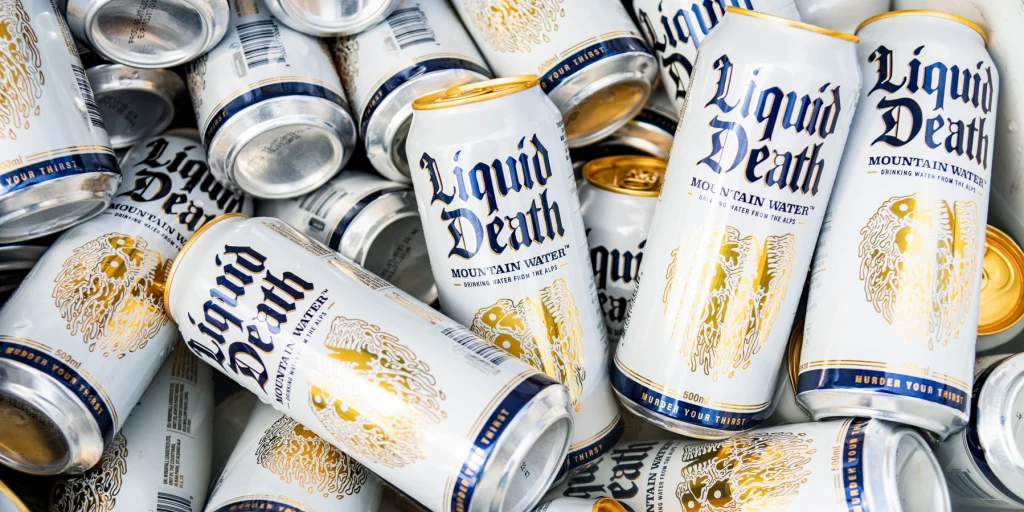
  • The Positioning: By using 500 ml aluminum cans that look exactly like beers, the brand allows consumers to feel socially integrated in nightlife and leisure environments. You are no longer “the awkward person drinking water at a party.”
  • The Packaging as the Message: This visual approach has allowed water to compete toe-to-toe with alcohol and sugary drinks at music festivals and concerts.

Choosing aluminum over plastic wasn’t just a design choice; it was a play for operational efficiency. Aluminum is infinitely recyclable, keeps the product colder for longer, and allows for denser, more cost-effective distribution. At ENEB, we emphasize that innovation isn’t always inside the product itself, but in the container and the perception it creates.

The Power of Emotional Branding and Irreverence

The tagline “Murder Your Thirst” is a blatant declaration of intent that shatters traditional corporate politeness. The brand leverages raw, hilarious, and deeply irreverent language that resonates perfectly with Gen Z and Millennials.

  • Aggressive Authenticity: In a world saturated with politically correct advertising, Liquid Death’s bold stance stands out like a beacon, turning the simple act of drinking water into a thrilling experience.
  • Monetizing the Hate: The brand does not fear polarization; it thrives on it. They went as far as releasing music albums where the lyrics were actual negative comments left by internet trolls.
  • Content-First Strategy: Instead of traditional ads, they publish high-quality entertainment pieces that audiences eagerly share organically, significantly lowering their Customer Acquisition Cost (CAC).

In modern marketing management, content must deliver standalone value before ever asking for a sale. Liquid Death is living proof that a brand can become its own media outlet.

Sustainability with an Aggressive, Authentic Narrative

Sustainability is typically marketed with imagery of lush green fields and clear blue skies. Liquid Death decided environmentalism could be dark, gritty, and direct. Under the banner “Death to Plastic,” they mobilized a consumer base that cares about the planet but is utterly exhausted by patronizing corporate tones.

This approach ensures that Corporate Social Responsibility (CSR) never feels like an afterthought forced by a PR department; it is woven into the company’s DNA. By funding ocean cleanup operations with a portion of their profits, they back up their words with action.

From a strategic standpoint, this narrative acts as a heavy barrier to entry for competitors. It is incredibly difficult for a legacy beverage conglomerate to adopt such a radical tone without alienating their conservative customer base.

Guerrilla Marketing and Social Media Dominance

The company’s digital footprint is a text-book case study for e-commerce growth. By mastering the algorithms of TikTok and Instagram, the brand scaled globally without relying on astronomical TV budgets.

  • Psychographic Segmentation: Instead of targeting consumers by traditional demographics like age or zip code, they target shared lifestyles, mindsets, and humor.
  • Merchandising Ecosystem: They successfully turned a water brand into a lifestyle label, getting people to buy and wear branded t-shirts, hats, and accessories. This turns customers into walking billboards who actually pay to promote the product.
  • Data-Driven Creativity: Behind the wild creative execution lies a rigorous data operation. They know precisely what type of humor converts and which influencer collaborations yield the highest Return on Investment (ROI).

Conclusion

The Liquid Death case study teaches us a fundamental truth: there are no boring products, only mediocre communication strategies. They have proven that even water can become a cult brand if you have the courage to defy established norms.

For the students and alumni of ENEB, this serves as a masterclass in humility and creativity. The market always carves out space for those who dare to be authentic. Today, we no longer just buy products—we buy narratives that validate our worldview. If you can sell water like it’s a rock concert, you can sell anything.