In today’s complex business ecosystem, differentiation is often the greatest challenge for any executive. Selling cutting-edge technology or exclusive services carries an intrinsic logic. However, marketing mineral water—the most basic and abundant commodity on earth—requires an extraordinary stroke of strategic genius.
From the perspective of the European Business School of Barcelona (ENEB), analyzing the Liquid Death case study is an absolute must. This brand doesn’t just sell a liquid; it sells an identity, a rebellion, and a community.
In the year 2026, we observe how this company has achieved a historic milestone in mass consumption, transforming an undifferentiated raw material into an object of desire for millions. Their strategy is not built on the chemical properties of water, but on consumer psychology. Through disruptive branding, they have broken every conventional rule in the beverage industry.
Below, we break down the keys to their success and how you can apply these lessons to your own business strategy.
Disrupting a Commodity: Canned Water with a Punk Aesthetic
Water is, by definition, a commodity. For decades, industry leaders have focused their messaging on purity, pristine springs, and family health. Liquid Death decided to run radically in the opposite direction. Founder Mike Cessario noticed that healthy beverage marketing was notoriously boring and predictable.
- The Insight: While energy drinks commanded aggressive, high-energy language, water remained in a therapeutic comfort zone. The brand decided to hijack the visual heavy artillery of heavy metal to sell hydration.
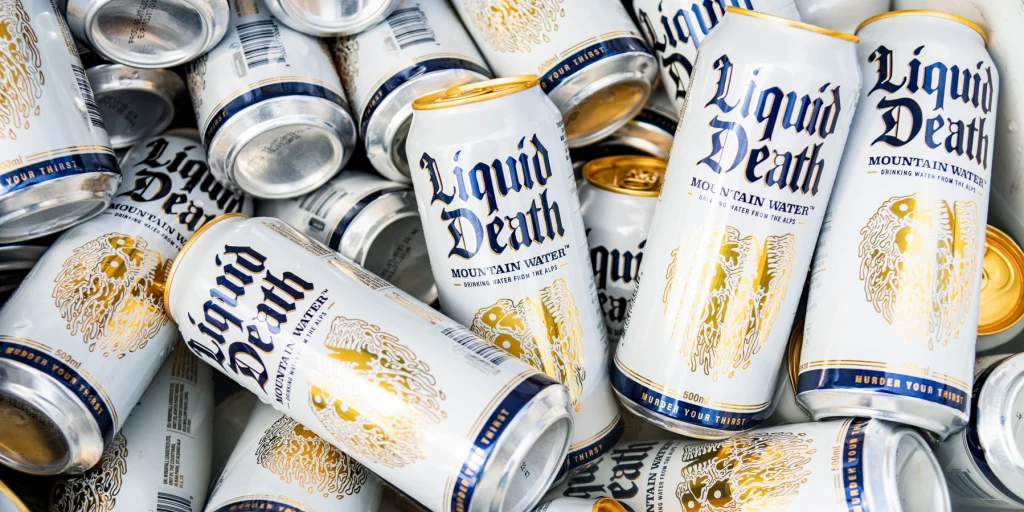
- The Positioning: By using 500 ml aluminum cans that look exactly like beers, the brand allows consumers to feel socially integrated in nightlife and leisure environments. You are no longer “the awkward person drinking water at a party.”
- The Packaging as the Message: This visual approach has allowed water to compete toe-to-toe with alcohol and sugary drinks at music festivals and concerts.
Choosing aluminum over plastic wasn’t just a design choice; it was a play for operational efficiency. Aluminum is infinitely recyclable, keeps the product colder for longer, and allows for denser, more cost-effective distribution. At ENEB, we emphasize that innovation isn’t always inside the product itself, but in the container and the perception it creates.
The Power of Emotional Branding and Irreverence
The tagline “Murder Your Thirst” is a blatant declaration of intent that shatters traditional corporate politeness. The brand leverages raw, hilarious, and deeply irreverent language that resonates perfectly with Gen Z and Millennials.
- Aggressive Authenticity: In a world saturated with politically correct advertising, Liquid Death’s bold stance stands out like a beacon, turning the simple act of drinking water into a thrilling experience.
- Monetizing the Hate: The brand does not fear polarization; it thrives on it. They went as far as releasing music albums where the lyrics were actual negative comments left by internet trolls.
- Content-First Strategy: Instead of traditional ads, they publish high-quality entertainment pieces that audiences eagerly share organically, significantly lowering their Customer Acquisition Cost (CAC).
In modern marketing management, content must deliver standalone value before ever asking for a sale. Liquid Death is living proof that a brand can become its own media outlet.
Sustainability with an Aggressive, Authentic Narrative
Sustainability is typically marketed with imagery of lush green fields and clear blue skies. Liquid Death decided environmentalism could be dark, gritty, and direct. Under the banner “Death to Plastic,” they mobilized a consumer base that cares about the planet but is utterly exhausted by patronizing corporate tones.
This approach ensures that Corporate Social Responsibility (CSR) never feels like an afterthought forced by a PR department; it is woven into the company’s DNA. By funding ocean cleanup operations with a portion of their profits, they back up their words with action.
From a strategic standpoint, this narrative acts as a heavy barrier to entry for competitors. It is incredibly difficult for a legacy beverage conglomerate to adopt such a radical tone without alienating their conservative customer base.
Guerrilla Marketing and Social Media Dominance
The company’s digital footprint is a text-book case study for e-commerce growth. By mastering the algorithms of TikTok and Instagram, the brand scaled globally without relying on astronomical TV budgets.
- Psychographic Segmentation: Instead of targeting consumers by traditional demographics like age or zip code, they target shared lifestyles, mindsets, and humor.
- Merchandising Ecosystem: They successfully turned a water brand into a lifestyle label, getting people to buy and wear branded t-shirts, hats, and accessories. This turns customers into walking billboards who actually pay to promote the product.
- Data-Driven Creativity: Behind the wild creative execution lies a rigorous data operation. They know precisely what type of humor converts and which influencer collaborations yield the highest Return on Investment (ROI).
Conclusion
The Liquid Death case study teaches us a fundamental truth: there are no boring products, only mediocre communication strategies. They have proven that even water can become a cult brand if you have the courage to defy established norms.
For the students and alumni of ENEB, this serves as a masterclass in humility and creativity. The market always carves out space for those who dare to be authentic. Today, we no longer just buy products—we buy narratives that validate our worldview. If you can sell water like it’s a rock concert, you can sell anything.