

Over the last decade, e-commerce seemed to have signed the death warrant for traditional retail. However, in the middle of 2026, we are witnessing a phenomenon as paradoxical as it is fascinating: the very digital giants that once confined us to screens are now investing billions into opening physical stores.
This movement is not a step backward; it is the logical evolution toward true omnichannel strategies. In a world saturated by algorithms, human contact has become the ultimate luxury.
From the perspective of the European Business School of Barcelona (ENEB), we analyze this trend as a pivotal shift in brand management. It is no longer just about selling products—it is about conquering the customer’s entire journey. Physical spaces have transformed into the most powerful marketing asset for building genuine brand loyalty.
The Digital Saturation Paradox of 2026
We live in an era where attention is the scarcest and most expensive resource on the market. Customer Acquisition Costs (CAC) on digital platforms have skyrocketed to unsustainable levels. Faced with this reality, tech companies have discovered a powerful truth:
- A Permanent Billboard: A brick-and-mortar storefront on a busy street works as a permanent, high-impact advertisement.
- Sensory Interaction: It unlocks tactile and immediate experiences that no web interface can currently replicate.
- Combating Digital Fatigue: The consumer of 2026 is suffering from deep screen fatigue. Neighborhood stores provide something algorithms consistently ignore: a sense of community and a human face behind the corporate logo.
Case Studies: Legacy Pixels Turning into Storefronts
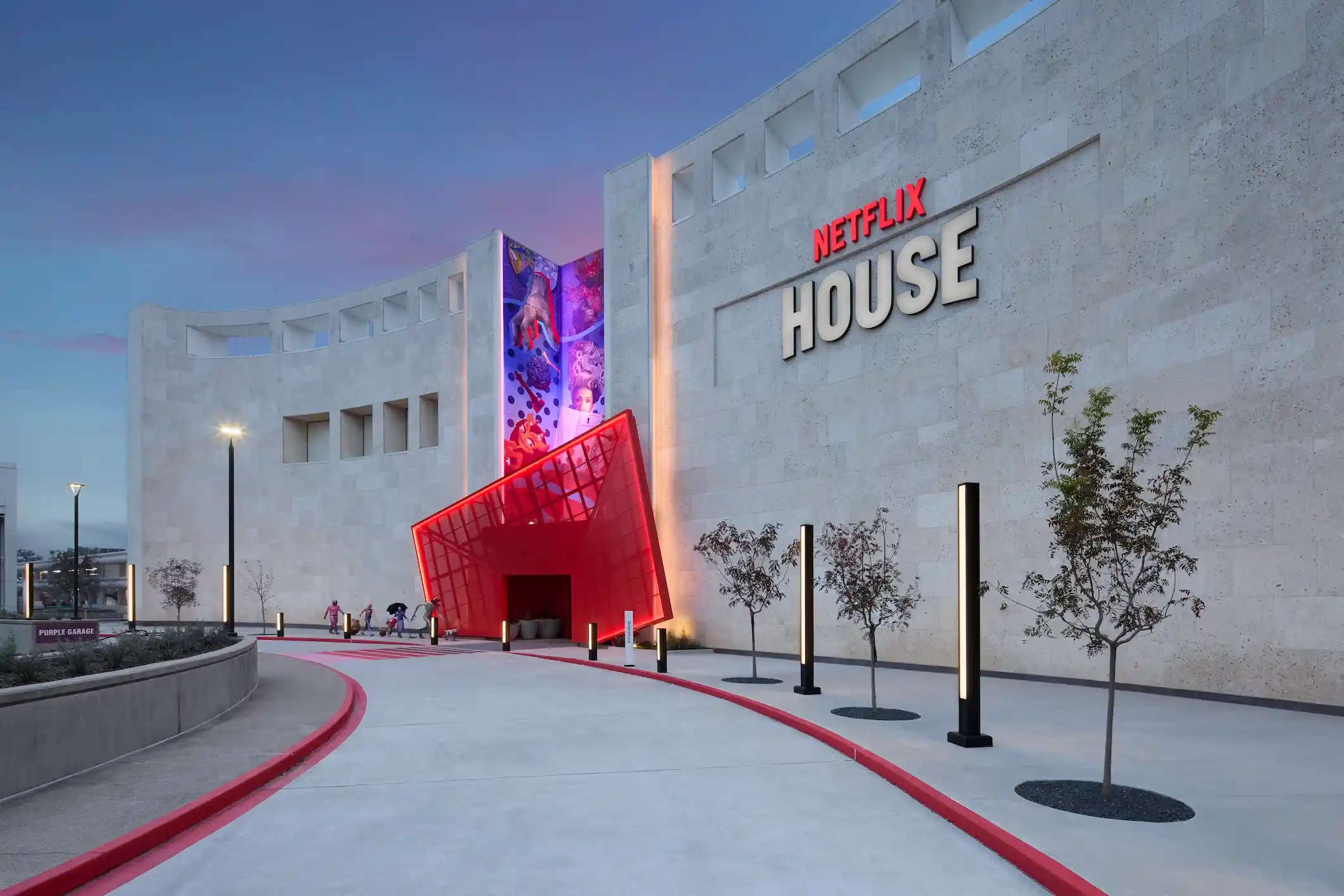
Netflix House: Bringing Fiction to Life
The streaming platform decided its stories needed to break out of the TV screen. Netflix House locations aren’t merely gift shops; they are experiential entertainment hubs where fans can dine on the recreated sets of their favorite shows, play immersive games, and buy exclusive merchandise.
The primary goal here isn’t immediate cash flow from retail sales. The true metric of success is scaling the time and emotional equity the user invests in the brand.
Amazon and the Conquest of Local Retail
Amazon’s aggressive plays with Amazon Fresh and localized pickup hubs highlight a structural logistics obsession. The e-commerce giant realized that the “last mile” becomes drastically more efficient when customers revolve around a physical node.
These neighborhood spots serve as:
- Micro-distribution centers.
- Frictionless return hubs.
- Offline data labs used to track consumer movement, item handling, and real-world friction points.
Omnichannel Strategy as the Foundation of Loyalty
Omnichannel operations are no longer a luxury—they are a survival requirement. Today’s consumer does not segment their world into “online” and “offline.” They discover a product on their phone, test it out in a showroom, and complete the checkout process via an app.
- Optimizing Reverse Logistics: In-store returns are significantly cheaper for an organization to process than residential courier pickups.
- Cross-Selling Ecosystems: When a customer walks through the door to return an online order, the probability of them making an impulse purchase in-store surges.
- Trust Capital: Face-to-face service resolves customer pain points with a level of empathy and speed that standard support chats cannot emulate.
Physical Spaces as the Ultimate Marketing Asset
Historically, commercial rent was classified strictly as an operational expense (OpEx). In 2026, modern marketing executives view it as a high-return media investment.
By targeting all five senses—using custom scents, curated soundscapes, and hands-on product interaction—brands build indelible memories. In an increasingly ephemeral virtual world, physical assets communicate security, stability, and permanence. This is precisely why tech titans are buying up premium real estate downtown: they want to anchor themselves in our daily physical reality.
Conclusion
The digital migration into physical retail confirms that the future of business is undeniably hybrid. For professionals trained at ENEB, this phenomenon provides a masterclass in operational adaptability. Leading tomorrow’s market requires managing both the digital grid and the physical world with equal expertise. In 2026, the corner store is the new frontier of tech innovation.